When Boeing developed the B-29 Stratofortress during WW II, it was soon realized that it was the beginning of a new plateau of aircraft technology. The USAAF and Boeing soon realized that an impressive transport aircraft could be developed from the bomber, and the Model 367 (C-97) was flying by the end of the war. The B-29's wings, engines, and tail were mated with a completely new fuselage, whose dimensions at that time looked fantastic. The front looked bluff and unstreamlined, but the maximum speed was calculated to be as high as the bomber's. The plane was tailored to the military's needs, but as the war was winding down, the aircraft manufacturer began to think of ways this new technology could be translated into an airliner derivative.
Pan American was very interested in the plane, but thought that it would be even better equipped with the new Wasp Major engine, then in development for the B-29's successor, the B-50. With the promise of an order from Pan Am, Boeing had refined the Model 377 with the new engines by 1946, with all the latest refinements, including full anti-icing, light alloy structure, and foldable tail. The interior would feature a two-deck arrangement, with luxurious furnishings and a spiral staircase to a downstairs bar/lounge.
In June 1946 Pan American cancelled it's DC-7 order (an earlier model quite different from the eventual DC-7) and ordered 20 377's, now named the Stratocruiser. Further orders came from Northwest, American Overseas, SAS, BOAC, and United. The Northwest and United examples were built slightly differently, the most obvious change being the square passenger windows. However, total production of the Stratocruiser only came to 56, with most airlines shying away from the complex Wasp Major engines with their twin General Electric turbos and Hamilton Standard hollow-steel square-tipped props. There were indeed many problems with the "Strat" as it was placed into service, but the competing Connies and DC-6's also had problems that even lead to their temporary grounding. SAS never actually took delivery, their four planes being added to the BOAC order.
The Stratocruiser was typically used in first class transatlantic service (except for the United and Northwest planes), and other international routes. However, they were rapidly replaced by other more economical aircraft in the late 50's and by jets in the early 60's, and were sold to other operators. Many of these were converted to cargo operations, and several were used in the "Guppy" rebuildings, resulting in grossly outsized fuselages for hauling such things as rocket sections and airplane parts. Others became transports for the Israeli air force.
Paint kit for GMAX B377 by Greg Pepper (13MB) or as modified by Dave McQueen (8.5 MB). Contains layered PSD files (usable in both Photoshop and Paint Shop Pro) which allow you to place your paint scheme between the bare metal layers and the windows and doors. Makes for fast painting! Greg's is based on a KC-97, Dave's is true bare metal with a layer for each type of airline window arrangement. Note: there are no instructions in the files; follow the detailed instructions in my PSP Repainting Tutorial.
KC-97E and KC-97G flight model updates. KC-97E and KC-97G, MDL updates. (Use Update Pack below for the latest B377 MDL and flight model files).
The Update Pack includes flight dynamics for American Overseas, Pan American, BOAC, Northwest, and RANSA versions, as well as the C-97A. Last updated on 6/21/13.
Click on the image to download the plane. Download the Base Pack to get the panel and sounds, then the Update Pack above for the other models. Then use the textures from the files below the Base Pack.
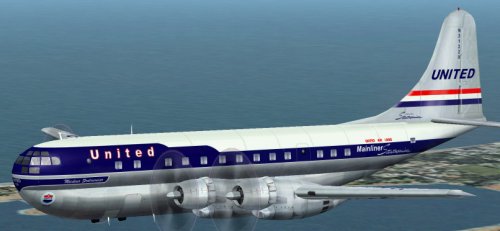 FS2004/FS2002 United Air
Lines Model 377 Stratocruiser Base Pack. Greg
Pepper has painted his 377 into United's classic paint scheme of the 50's. This
is the later white top version - early on they were painted with bare metal
tops. These planes flew on United's routes from California to Hawaii,
and were the most luxurious planes in United's fleet. They were sold in 1954
to BOAC, due to high operating costs, and the arrival of the DC-7's. Comes
complete with panel and sounds. Last updated on 6/21/13.
FS2004/FS2002 United Air
Lines Model 377 Stratocruiser Base Pack. Greg
Pepper has painted his 377 into United's classic paint scheme of the 50's. This
is the later white top version - early on they were painted with bare metal
tops. These planes flew on United's routes from California to Hawaii,
and were the most luxurious planes in United's fleet. They were sold in 1954
to BOAC, due to high operating costs, and the arrival of the DC-7's. Comes
complete with panel and sounds. Last updated on 6/21/13.
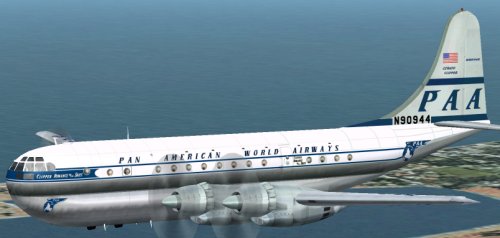 FS2004/FS2002 Pan American World
Airways Model 377 Stratocruiser. Dave McQueen and Rui Cristina have
repainted Greg's new Stratocruiser into the classic Pan American colors. It
looks great, doesn't it? Pan American used these on their premier routes,
primarily trans-Atlantic and trans-Pacific runs. They were the height
of luxury - a time that is long past. Thanks, Dave and Rui! Part
of a PAA/TALOA combined package (17MB). Use only the textures
from this package and add to the Update
Pack. Last updated on 6/27/03. FS2004
Radar equipped version painted by Wayne Tudor. Textures only - requires
the Update Pack.
Last updated on 4/25/05. The update pack also includes flight dynamics
for a PAA Super Stratocruiser, if desired. Also download and install
the UAL Base Pack to get the panel and sounds.
FS2004/FS2002 Pan American World
Airways Model 377 Stratocruiser. Dave McQueen and Rui Cristina have
repainted Greg's new Stratocruiser into the classic Pan American colors. It
looks great, doesn't it? Pan American used these on their premier routes,
primarily trans-Atlantic and trans-Pacific runs. They were the height
of luxury - a time that is long past. Thanks, Dave and Rui! Part
of a PAA/TALOA combined package (17MB). Use only the textures
from this package and add to the Update
Pack. Last updated on 6/27/03. FS2004
Radar equipped version painted by Wayne Tudor. Textures only - requires
the Update Pack.
Last updated on 4/25/05. The update pack also includes flight dynamics
for a PAA Super Stratocruiser, if desired. Also download and install
the UAL Base Pack to get the panel and sounds.
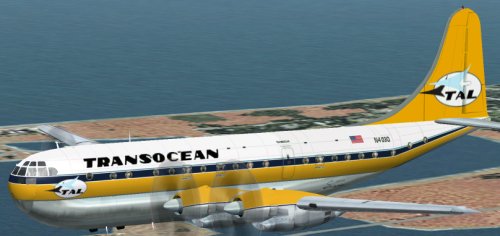 FS2004/FS2002
Transocean Model 377 Stratocruiser. Transocean operated 8 of the
14 ex-BOAC Stratocruisers they owned from 1958-1960 on international and domestic
supplemental routes. However, their high operating costs did not help in the
low cost supplemental market! Dave McQueen and Rui Cristina painted Greg's
new Strat into bright Transocean colors. Thanks again! Part of a PAA/TALOA
combined package (17MB). Use only the textures from this package
and add to the Update
Pack. Last updated on 6/28/03. Also download and install
the UAL Base Pack to get the panel and sounds.
FS2004/FS2002
Transocean Model 377 Stratocruiser. Transocean operated 8 of the
14 ex-BOAC Stratocruisers they owned from 1958-1960 on international and domestic
supplemental routes. However, their high operating costs did not help in the
low cost supplemental market! Dave McQueen and Rui Cristina painted Greg's
new Strat into bright Transocean colors. Thanks again! Part of a PAA/TALOA
combined package (17MB). Use only the textures from this package
and add to the Update
Pack. Last updated on 6/28/03. Also download and install
the UAL Base Pack to get the panel and sounds.
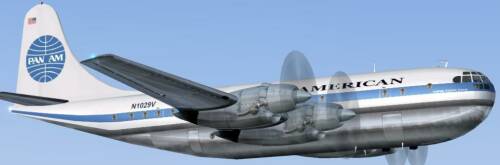 FS2004 Pan Am Model 377 Stratocruiser.
Wayne Tudor has repainted Greg's Stratocruiser into the modernistic Pan
Am colors that the Strat's wore just prior to retirement. Thanks, Wayne!
Textures only - requires the Update
Pack. Last updated on 4/5/05. Radar
equipped version painted by Wayne Tudor. Textures only - requires
the Update Pack.
Last updated on 4/25/05. The update pack also includes flight dynamics
for a PAA Super Stratocruiser, if desired. Also download and install
the UAL Base Pack to get the panel and sounds.
FS2004 Pan Am Model 377 Stratocruiser.
Wayne Tudor has repainted Greg's Stratocruiser into the modernistic Pan
Am colors that the Strat's wore just prior to retirement. Thanks, Wayne!
Textures only - requires the Update
Pack. Last updated on 4/5/05. Radar
equipped version painted by Wayne Tudor. Textures only - requires
the Update Pack.
Last updated on 4/25/05. The update pack also includes flight dynamics
for a PAA Super Stratocruiser, if desired. Also download and install
the UAL Base Pack to get the panel and sounds.
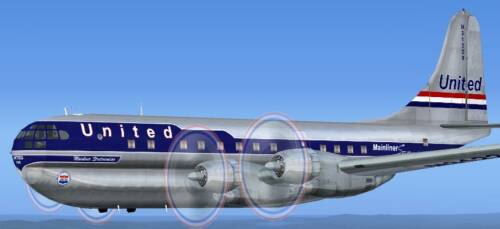 FS2004 United Model 377 Stratocruiser. Wayne Tudor has painted
the Strat into the bare metal delivery colors of United. They flew for most
of their time at United in these colors between California and Honolulu. Thanks!
Textures only - requires the UAL Base Pack.
Last updated on 4/5/05.
FS2004 United Model 377 Stratocruiser. Wayne Tudor has painted
the Strat into the bare metal delivery colors of United. They flew for most
of their time at United in these colors between California and Honolulu. Thanks!
Textures only - requires the UAL Base Pack.
Last updated on 4/5/05.
 FS2004 BOAC Model
377 Stratocruiser. Here's the Stratocruiser that's been painted into
the classic conservative colors of British Overseas Airways. There are
three different liveries included. Dave McQueen and Rui Cristina have done a
great job! Thanks, guys! Use only the textures from this
package and add to the Update
Pack. Last updated on 8/3/03. Also download and install
the UAL Base Pack to get the panel and sounds.
FS2004 BOAC Model
377 Stratocruiser. Here's the Stratocruiser that's been painted into
the classic conservative colors of British Overseas Airways. There are
three different liveries included. Dave McQueen and Rui Cristina have done a
great job! Thanks, guys! Use only the textures from this
package and add to the Update
Pack. Last updated on 8/3/03. Also download and install
the UAL Base Pack to get the panel and sounds.